
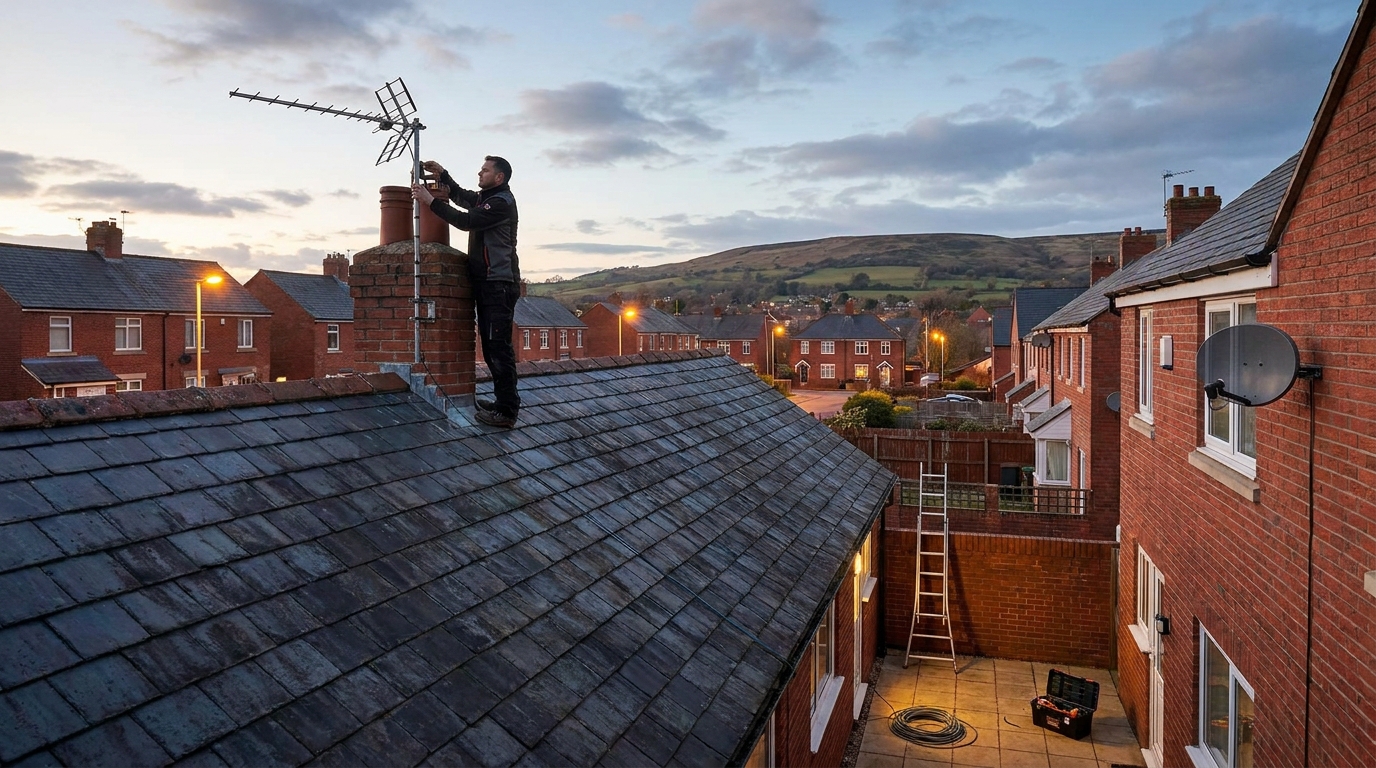
Whether you have just moved into a new home or your old analogue aerial has finally given up the ghost, getting the right TV aerial installation makes all the difference to your viewing experience. A properly installed digital aerial can unlock over 100 free-to-air channels through Freeview, delivering crystal-clear pictures without the need for a monthly subscription. In this guide, we walk you through everything you need to know about TV aerial installation in the UK, from DIY considerations and cable assembly through to loft versus outdoor setups and signal distribution.
Why TV Aerial Installation Matters
The shift from analogue to digital television transformed what UK homeowners can receive through a standard rooftop or loft aerial. Where an ageing analogue setup might only deliver a handful of channels, a correctly installed digital Freeview aerial can open up a world of entertainment. One of our customers put it perfectly:
"I went from having 17 channels using an old analogue aerial, to over 100 channels without the need for a booster after Abacus fitted our Digital Freeview Aerial."
Getting the installation right from the start is what separates a frustrating viewing experience from one you can truly enjoy. The quality of the aerial, the positioning, the cable run, and the connectors all play a vital role. That is why it is worth understanding each element before you decide whether to tackle the job yourself or call in a professional.
DIY TV Aerial Installation: What You Need to Know
Many homeowners consider DIY aerial installation as a way to save money. While it is certainly possible to fit a basic aerial yourself, there are several factors that can catch you out if you are not familiar with the process.
First, you will need to identify your nearest transmitter. Ofcom's transmitter maps can help you locate the correct transmitter for your area, which in turn determines the direction your aerial needs to face. Pointing your aerial towards the wrong transmitter is one of the most common causes of poor signal.
You will also need to select an aerial that is appropriate for your signal area. Aerial types are colour-coded (Group A through to Group K in the UK) to correspond with the frequency band used by your nearest transmitter. Using the wrong group aerial, even if it looks similar, will result in a weak or absent signal.
If you are confident working at height and comfortable handling basic electrical components, a straightforward replacement in a good signal area may be manageable. However, for anything more complex, including cable runs through walls, multi-room distribution, or low-signal locations, a professional installation is the safer and more reliable choice.
Coaxial Aerial Cable Assembly and Connector Fitting
The coaxial cable is the backbone of your aerial system. A poor connection at either end of the cable run will degrade your signal, regardless of how good the aerial itself is.
Coaxial cable consists of a central copper conductor, a dielectric insulator, a metallic shielding braid, and an outer plastic jacket. When fitting a coaxial TV connector plug, you need to carefully strip back each layer to the correct length without damaging the inner conductor or disturbing the shielding braid. The braid folds back over the plug body to create the earth connection, while the central conductor seats firmly into the pin.
For satellite and some aerial connections, an F-connector is used instead of a standard coaxial plug. F-connectors compress onto the cable using a crimp or compression tool and provide a weatherproof, low-loss connection that is particularly important for outdoor installations.
Poorly crimped connectors are one of the leading causes of signal loss and intermittent picture quality. If you are assembling your own cable runs, investing in a quality compression tool and using the correct connector type for your cable's outer diameter is essential.
Loft Antenna Installation vs. Outdoor TV Aerial Setup
One of the most common questions we hear is whether it is better to install an aerial in the loft or outside on the roof. Both approaches have their merits, and the right choice depends on your location, the strength of your local signal, and your property's construction.
Loft Antenna Installation
A loft aerial is protected from the elements, which means it is less susceptible to weathering, corrosion, and physical damage. It is also far easier and safer to access for maintenance or adjustment. However, the roofing materials surrounding a loft aerial will attenuate the incoming signal. Tiles, felt, and insulation all reduce signal strength to varying degrees. In areas with a strong transmitter signal, a loft installation can work perfectly well. In marginal signal areas, the additional attenuation of the roof structure may push an already weak signal below the threshold needed for reliable reception.
Outdoor TV Aerial Setup
An externally mounted aerial, fitted to a chimney stack, gable end, or dedicated wall bracket, receives the signal without any structural obstruction. This makes it the preferred solution in low-signal areas or where a clear line of sight to the transmitter is required. The trade-off is exposure to wind, rain, and UV, so the quality of the aerial, fixings, and cable entry point all need to be specified for outdoor use.
In our experience, a properly selected and positioned outdoor aerial will almost always outperform a loft-mounted equivalent at the same property.
TV Aerial Signal Distribution and Amplifiers
If you want to distribute your aerial signal to multiple rooms, you will need a signal splitter or a distribution amplifier. Every time you split a signal, you reduce its strength, so in a multi-room setup it is important to ensure there is sufficient signal headroom before distribution.
A TV aerial distribution amplifier boosts the incoming signal before it is split, compensating for the losses introduced by the passive splitters and cable runs. However, as the BBC's guidance on amplifiers notes, fitting an amplifier where the signal is already strong can actually cause overload and degrade picture quality. The key is accurate signal measurement at the aerial point before deciding on the right amplifier gain.
For homes in strong signal areas, a simple passive two-way or four-way splitter may be all that is needed. For properties with long cable runs or many outlet points, a masthead amplifier fitted directly at the aerial, where the signal is at its strongest, will deliver the best results.
Why Professional TV Aerial Installation Is Worth It
We understand that letting tradespeople into your home is not a decision you take lightly. That is why we go out of our way to make every visit as professional, tidy, and respectful as possible. As one of our customers told us:
"You are always worried about letting workmen into your house, but Abacus Aerials were excellent. Perfect pictures in every room and no mess. The price was a pleasant surprise as well. Well done!"
We also know that when your television is not working, you want it sorted quickly. Our process is straightforward: request a call or get in touch with us, and we will arrange for an engineer to visit. As another satisfied customer noted:
"An engineer came to give a quote and then completed the work within 2 days. I was delighted with the service, his manner, speed and efficiency. Thank you very much, I would recommend your company to anyone."
We also tackle the installations that others say cannot be done. One customer was told they could not receive a digital signal at their address, only to find that was not the case:
"I was told I couldn't get digital where I live but Abacus Aerials managed to do it."
Our aerials and satellite services cover the full range of domestic aerial installation requirements, from straightforward digital upgrades through to complex multi-room distribution systems.
A Complete Home Entertainment Solution
TV aerial installation is just the starting point. Once your signal is sorted, you might find yourself thinking about the rest of your home entertainment setup. We offer a comprehensive range of installation services to complement your aerial system, including home cinema installation, sound system installation, Wi-Fi network installation, and home automation. For those looking to go further, we also install CCTV systems to help keep your property secure.
Whatever your home entertainment or security requirements, we are here to help. Contact us today to request a call from one of our engineers and take the first step towards a better viewing experience.
